
How to Change Medium in Spheroid and Organoid Cultures Without Losing 3D Cultures
Spheroid and organoid medium exchange is difficult for one simple reason: the biology is not firmly attached. If aspiration is too fast, the tip is placed too centrally, or too much liquid is removed, spheroids, organoids, tumoroids, or microtissues can shift, break apart, dry out, or disappear into the pipette.
To avoid this, medium exchange should be treated as a controlled fluid-handling step, not as a simple pipetting task. Aspirate gently, work at the well wall or exchange ledge instead of the center, and leave a defined residual volume rather than trying to remove every last microliter.
For most labs, the safest way to change medium in spheroid and organoid cultures is to minimize local flow around the 3D structure. That means using slow aspiration and dispense rates, keeping the plate stable, and choosing a residual volume that protects the culture even if it slightly reduces exchange efficiency.
In specialized spheroid or organoid plates, lower residual volumes may be possible. In generic U-bottom, round-bottom, or ULA plates, a more conservative starting point is usually better. For organoids embedded in Matrigel, Geltrex, Cultrex, or another ECM dome, the same principle applies, but with an additional constraint: the gel dome itself must not be disturbed or allowed to dry out.
For ECM-supported cultures, see the related guidance on Matrigel dome dispensing and ECM handling and temperature control for Matrigel, Geltrex, and Cultrex.
Quick answer
To change medium in spheroid and organoid cultures without losing 3D cultures, minimize local flow around the spheroid, organoid, tumoroid, or microtissue. Aspirate slowly from the sidewall or exchange ledge, avoid central tip placement, leave a protective residual volume, and refill gently along the well wall. The safest method usually prioritizes culture retention over maximum exchange fraction, especially for fragile, newly formed, loosely compacted, 384-well, or ECM-supported cultures. For organoids embedded in Matrigel, Geltrex, or Cultrex, keep the dome covered, avoid drying, and do not aspirate or dispense directly onto the matrix.
Why spheroids and organoids are often lost during medium exchange
Unlike adherent cell monolayers, many 3D cultures are held in place mainly by gravity, well geometry, matrix support, or their own structural integrity. That makes them sensitive to local flow, sudden suction, plate movement, and aggressive refill from above.
Medium should therefore be removed and added at the side of the well, not through a forceful central exchange step. In specialized spheroid and organoid plates, dedicated exchange ledges or geometry features can make this easier by separating the aspiration point from the culture position.
For laboratories that need standardized handling across many wells and plates, WASH+ automated medium exchange is designed to reduce local flow and tissue disturbance.
A second common mistake is over-optimizing for maximum exchange instead of maximum retention. In practice, a slightly larger residual volume is often the right trade-off, especially for fragile, small, newly formed, loosely compacted, or matrix-supported 3D cultures.
This is especially relevant for organoid workflows. Some organoids are compact and robust, while others are irregular, fragile, embedded in ECM, or present as smaller fragments. A medium exchange method that works well for one spheroid model may still be too aggressive for a sensitive organoid culture.
A practical manual workflow for gentle spheroid and organoid medium exchange
Before starting, let the plate sit flat and undisturbed for a short moment so the spheroids or organoids are in their expected position. Handle the plate smoothly and avoid abrupt movements. For non-adherent 3D cultures, even transport can disturb the biology, so unnecessary motion should be minimized.
For a plate-format-specific workflow, see the related guide on manual medium exchange workflow for spheroids and organoids.
When removing spent medium, place the pipette tip at the well wall rather than in the center of the well. In plates with a dedicated exchange ledge, work from that ledge. In round-bottom or ULA plates without such a feature, stay high and lateral rather than deep and central. The goal is to remove liquid while keeping the flow path away from the spheroid, organoid, or microtissue itself.
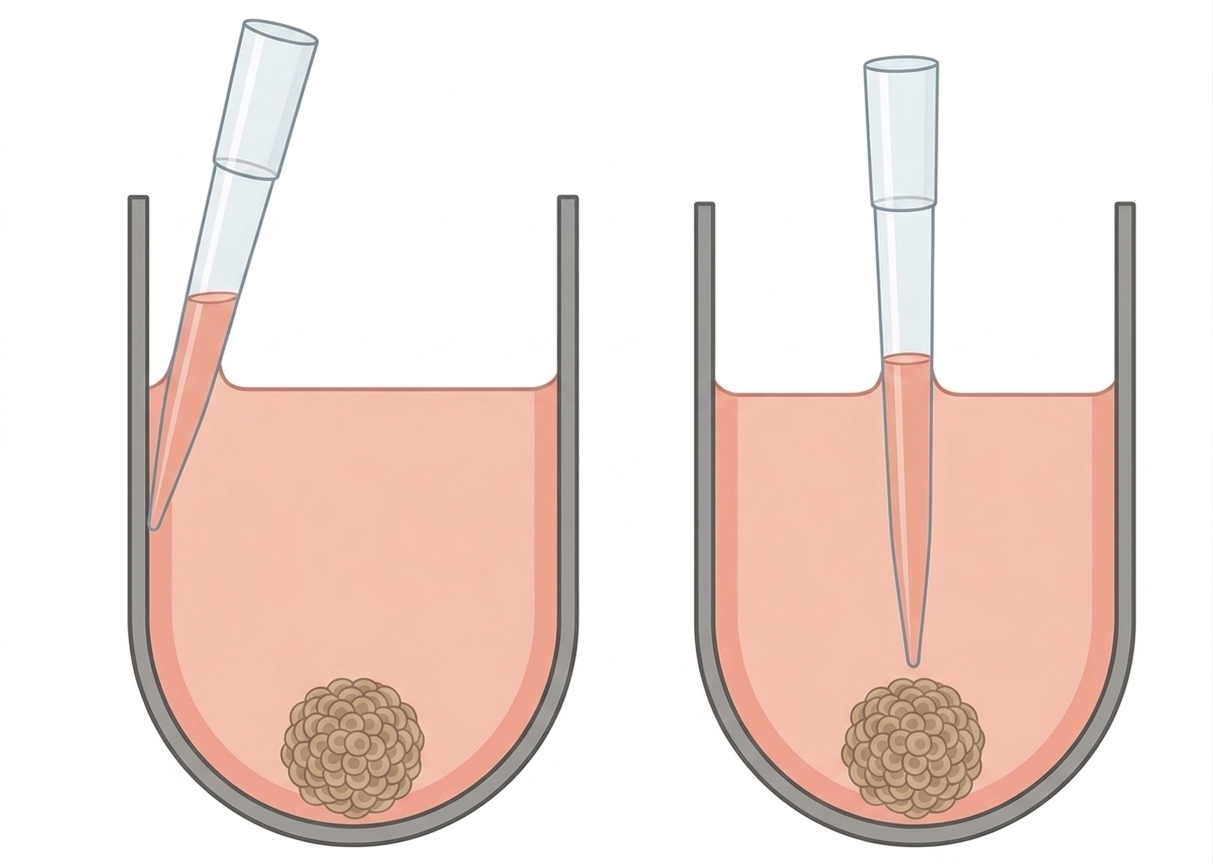
Aspirate slowly. For manual workflows, “slowly” matters more than “quickly but carefully.” Use low aspiration rates and increase speed only after confirming that the 3D culture remains undisturbed.
Do not try to empty the well completely on the first attempt. Leave a residual volume that protects the spheroid or organoid from direct suction and reduces abrupt fluid motion near the culture compartment. In some 3D culture plate systems, 10–20 µL can be a reasonable conservative starting range for 96- and 384-well medium exchange, while specialized exchange geometries can support lower residual volumes.
In standard round-bottom 96-well spheroid or organoid workflows, starting with a much larger residual fraction can be the safer choice until the exact behavior of the plate, medium, matrix, and 3D culture type is known.
When adding fresh medium, again work at the wall rather than dispensing directly onto the 3D culture. Refill slowly enough that the incoming liquid climbs the wall and spreads into the well instead of hitting the spheroid or organoid as a jet.
For ECM-embedded organoids, avoid dispensing directly onto the gel dome. Add medium gently to the side of the well and keep the dome covered. The goal is to exchange the liquid phase without mechanically damaging the matrix or exposing the culture to drying.
If the same protocol also includes matrix placement, use the related ECM handling guidance above to plan dome formation, temperature control, and gentle medium addition.
Finally, keep the workflow consistent across wells. Medium exchange becomes unreliable when tip depth, angle, aspiration speed, refill speed, or residual volume vary from one column to the next. Even if the method “works,” inconsistent technique will usually show up later as well-to-well variability, unexpected assay noise, or unexplained outliers.
Starting points by culture and plate type
| Culture or plate type | Safest initial tip position | Residual volume strategy | Practical note |
|---|---|---|---|
| Standard 96-well round-bottom or ULA spheroid plate | Sidewall, away from center | Start conservatively; often more residual is needed than in adherent-cell workflows | Optimize empirically for your plate and spheroid stability. |
| Standard 96-well organoid workflow | Sidewall, away from organoids or matrix | Leave enough medium to avoid suction, drying, or matrix disturbance | Especially important for fragile organoids, tumoroids, and organoid fragments. |
| Standard 384-well spheroid or organoid workflow | Sidewall, very controlled depth | Leave more than you think you need at first; small wells are less forgiving | Use especially slow aspiration and refill. |
| Specialized spheroid or organoid plate with exchange ledge | Exchange ledge | Lower residual volumes may be achievable | Ledge-based exchange helps separate fluid handling from the 3D culture position. |
| ECM-embedded organoids in Matrigel, Geltrex, or Cultrex | Sidewall, away from the dome | Keep the dome covered and avoid drying | Do not aspirate directly near the matrix dome. |
Common mistakes that cause spheroid or organoid loss
The most common error is placing the tip too close to the 3D culture. In generic plates, that often means going too deep or too central. In specialized plates, it can mean ignoring the exchange ledge and aspirating from the wrong position.
The second major error is aspirating too aggressively. Smaller, less compact, or less mature 3D cultures usually require gentler settings than large, tight spheroids. What works for one model may be too harsh for another.
A third mistake is chasing near-complete exchange during a manual process. Higher exchange fractions can look attractive on paper, but if retention suffers, the workflow becomes biologically and analytically worse. A stable residual volume with high retention is usually better than an aggressive exchange step that causes variable tissue loss.
For organoid cultures, another common error is treating every format like a free-floating spheroid. Organoids in ECM domes, droplets, or hydrogel-supported cultures have additional mechanical constraints. Medium exchange should not damage the matrix, expose the dome to air for too long, or create shear forces that detach or fragment the culture.
And finally, do not treat all plates the same. Well geometry matters. A method that behaves well in a plate with a dedicated exchange ledge may fail in a generic U-bottom or round-bottom format, and 384-well plates usually need tighter process control than 96-well plates.
When manual medium exchange reaches its limit
Manual medium exchange is often acceptable at small scale, especially during assay development or early feasibility work. But as plate counts rise, manual workflows usually become harder to standardize. Small differences in speed, tip depth, angle, and timing accumulate quickly, and those differences are amplified in fragile 3D cultures.
Automated spheroid and organoid medium exchange can help improve reproducibility, reduce handling variability, and maintain gentle fluid movement over many repeated wells or plates.
That is the main reason automated systems are attractive in 3D cell culture workflows: they do not just save time, they reduce operator-dependent variability.
WASH+ describes a WELLJET-based workflow that aspirates from the liquid surface, leaves a tunable residual volume, and dispenses along the well wall, with compatibility across 96- and 384-well plates and no physical WELLJET retrofit required.
We show residual volumes down to 5 µL in Akura-style plates and typical processing times of about 2 minutes for 96-well plates and about 5 minutes for 384-well plates.
Conclusion
If you want to change medium in spheroid or organoid cultures without losing 3D cultures, the safest approach is usually not to maximize exchange, but to minimize disturbance.
Keep the plate stable, aspirate at the sidewall or exchange ledge, use slow settings, leave a protective residual volume, and refill gently along the wall. For ECM-embedded organoids, also make sure the matrix dome remains covered and undisturbed.
Once that manual method is stable, you can optimize toward lower residual volume or higher throughput. If the workflow still depends too heavily on operator skill, that is usually the point where automation becomes worthwhile.